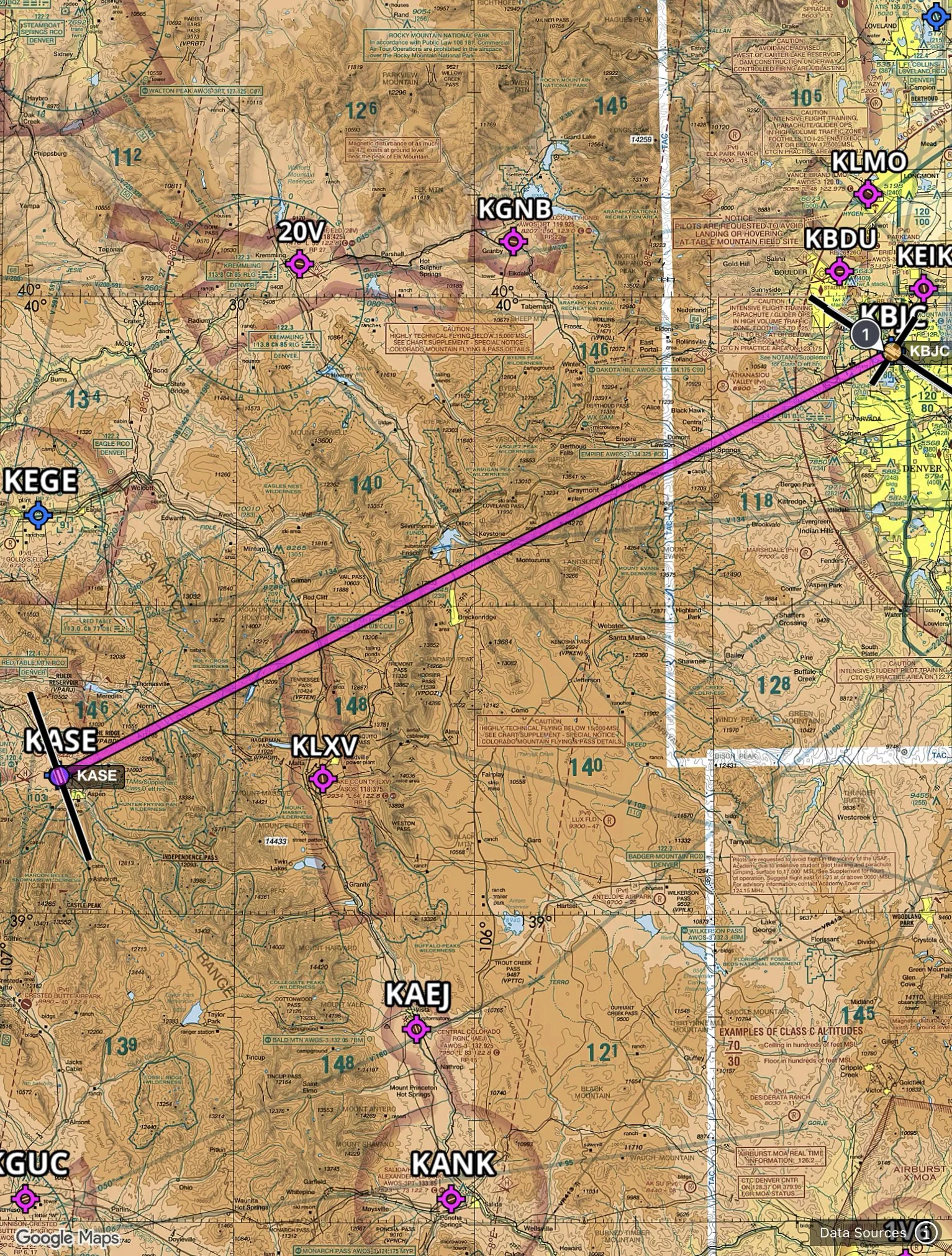
Route Planning in Mountain Terrain
Mountain flying route planning is about more than drawing a direct line between two airports.

In mountainous terrain, the safest route is not always the shortest route. Terrain, wind, weather, aircraft performance, altitude capability, emergency options, and pilot experience all influence the decision. A good mountain route gives the pilot options — room to turn around, lower terrain alternatives, suitable diversion airports, and enough performance margin to manage changing conditions.

Effective mountain route planning is not just navigation. It is risk management.
Why Route Planning Matters
Flying in mountain terrain requires a different mindset than flying across flat terrain.
A route that looks simple on a GPS or moving map may cross high ridgelines, narrow valleys, rising terrain, areas of strong wind, limited forced landing options, or passes that become unusable when ceilings lower. The FAA has cautioned that mountain flying involves more risk than flatland flying, and FAA Safety Briefing notes that route planning in mountainous areas requires more care than simply following the “magenta line.”
A well-planned mountain route should account for:
Terrain elevation
Ridge and pass crossings
Winds aloft
Weather trends
Density altitude
Aircraft climb performance
Fuel reserves
Alternate airports
Emergency landing options
Escape routes and turn-around areas
The goal is not simply to reach the destination. The goal is to preserve options throughout the flight.
Direct Routes Are Not Always Better
Modern GPS and flight planning tools make it easy to fly direct. In the mountains, direct routing can sometimes create unnecessary risk.

A direct route may take the aircraft:

Over higher terrain than necessary
Across limited emergency landing areas
Into stronger winds or turbulence
Through narrow valleys
Toward rising terrain with few escape options
Away from roads, airports, or suitable diversion areas

Mountain flying often rewards routes that follow lower terrain features, valleys, highways, rivers, or established passes. These routes may add distance, but they can provide better terrain clearance, more emergency options, and improved situational awareness. FAA Safety Briefing specifically recommends that safer mountain routes often follow features such as highways, river drainages, and valleys rather than simply drawing a straight line across terrain.
Terrain, Passes, and Ridge Crossings
Terrain is the central planning factor in mountain flying.
Before flying a mountain route, pilots should understand:
The highest terrain along the route
Minimum safe altitudes
Pass elevations
Ridge orientation
Valley direction
Nearby lower terrain
Where turn-around options exist
Where escape routes disappear
Ridge crossings require particular attention. A good plan should include enough altitude to cross with margin, an understanding of wind direction, and an approach angle that allows the pilot to turn away from terrain if conditions become unfavorable.
Avoid pointing the aircraft directly at rising terrain without room to maneuver. Once terrain begins climbing faster than the aircraft, options can disappear quickly.
Wind and Weather Along the Route
Mountain routes should be planned with wind and weather in mind, not just terrain.
Strong winds over ridges can produce turbulence, mountain wave, rotor activity, and downdrafts. A route that appears reasonable in calm conditions may become unsuitable when winds aloft increase or when the wind direction creates strong mechanical turbulence across the terrain.
Before selecting a route, evaluate:
Winds aloft at planned crossing altitudes
Wind direction relative to ridgelines
PIREPs for turbulence or mountain wave
Cloud bases along passes and ridges
Visibility along the route
Convective development later in the day
Freezing levels and icing risk
Alternate routes if weather changes
The FAA’s Tips on Mountain Flying includes conservative recommendations used by the Colorado Pilots Association for inexperienced mountain pilots, including winds aloft below 25 knots at 9,000 and 12,000 feet and ceilings at least 2,000 feet above ridges and passes along the route. These are not legal minimums, but they are useful planning references for conservative decision making.
Aircraft Performance and Density Altitude
Route planning must be matched to aircraft performance.
High terrain often requires higher cruise altitudes, longer climbs, and careful consideration of climb capability. In warm conditions, density altitude can reduce engine power, propeller efficiency, wing lift, and climb performance. This can make terrain clearance and escape planning more difficult.
Before committing to a mountain route, consider:
Can the aircraft comfortably climb to the planned altitude?
How long will the climb take?
What will the climb rate be at altitude?
What is the aircraft’s performance at the expected weight and temperature?
Is there enough margin if downdrafts are encountered?
Are there lower terrain routes available?
Is an early morning departure a better option?
A route that is reasonable for one aircraft may not be appropriate for another. Pilot experience, aircraft loading, temperature, and wind can change the answer.
Fuel, Alternates, and Diversions
Fuel planning in mountain terrain should be conservative.
Mountain routes may limit airport options, increase climb time, require deviations around weather or terrain, and make direct diversion routes impractical. A pilot may need to follow valleys, reverse course, or continue to a more suitable airport rather than simply turn direct to the nearest airport.
Good planning should identify:
Primary destination
Enroute fuel stops
Suitable alternate airports
Lower terrain diversion routes
Airports with services and runway length
Areas where communication may be limited
Weather trends at alternates
Decision points along the route
A strong plan includes more than one way out.
Checkpoints and Situational Awareness
Mountain flying can make navigation deceptively challenging.
Terrain can look similar from the air, GPS reception may not eliminate the need for terrain awareness, and valleys or ridgelines may lead pilots toward areas they did not intend to enter.
Use clear checkpoints such as:
Passes
Valleys
Roads
Rivers
Reservoirs
Towns
Airports
Distinct ridgelines
The FAA’s Pilot’s Handbook of Aeronautical Knowledge describes basic VFR navigation planning as including plotting a course, selecting checkpoints, measuring distances, and obtaining weather information. In mountain terrain, those same fundamentals become even more important because each checkpoint should also support terrain awareness and decision making.
Decision Points
One of the most useful mountain route planning habits is establishing decision points before departure.
A decision point is a location where the pilot intentionally evaluates whether to continue, turn around, divert, climb, descend, or choose an alternate route.
Examples include:
Before entering higher terrain
Before crossing a pass
Before entering a narrow valley
Before committing to a long segment without airports
Before continuing into lowering ceilings
Before departing an intermediate airport in the afternoon
Decision points prevent pilots from slowly drifting into reduced options. They create planned moments to pause, reassess, and make conservative choices.
Common Route Planning Mistakes
Common mistakes in mountain route planning include:
Following the GPS direct course without evaluating terrain
Underestimating winds aloft
Planning too close to terrain
Failing to identify escape routes
Ignoring density altitude and climb performance
Waiting too long to turn around
Assuming weather will improve along the route
Choosing a route with limited diversion options
Flying into valleys without enough room to reverse course
Treating legal VFR minimums as adequate mountain weather minimums
Most route planning mistakes are not dramatic at first. They usually begin with small reductions in margin.
Practical Route Planning Questions
Before flying a route through mountain terrain, ask:
What is the highest terrain along the route?
What altitude provides a realistic margin?
Are winds aloft compatible with the terrain?
Are clouds and visibility suitable for passes and ridgelines?
Does the aircraft have enough climb performance at expected weight and temperature?
Where are the escape routes?
Where are the lower terrain alternatives?
What airports are available if the route becomes unsuitable?
What is the latest point where turning around remains easy?
Would an earlier departure, lighter aircraft, or different route reduce risk?
If the route only works when everything goes perfectly, it is probably not a good mountain route.
A Professional Route Planning Mindset
Mountain route planning rewards discipline, patience, and humility.
The safest route is often the one that preserves the most options, even if it adds time or distance. Good mountain pilots are not trying to prove they can force a route through difficult terrain. They are trying to make thoughtful decisions that maintain margin from departure to destination.
In mountain flying, route planning is not just about where the airplane will go.
It is about where the airplane can safely go next if the plan changes.